Buy evgym.com ?
We are moving the project
evgym.com .
Are you interested in purchasing the domain
evgym.com ?
domain@kv-gmbh.de · 0541-91531010
Buy evgym.com ?
Are these pigment disorders?
Yes, these are pigment disorders. Pigment disorders refer to conditions that affect the color of the skin, hair, or eyes. In this case, the examples provided - albinism, vitiligo, and melasma - are all pigment disorders that result in abnormal pigmentation of the skin. Albinism is characterized by a lack of melanin production, vitiligo causes patches of depigmented skin, and melasma leads to dark patches on the skin. **
Is this a pigment disorder?
Yes, vitiligo is a pigment disorder that causes the skin to lose its color in patches. It occurs when the cells that produce melanin, the pigment that gives skin its color, are destroyed. This results in white patches on the skin that can vary in size and location. **

Similar search terms for Pigment
Top-Angebote
Products related to Pigment:
-
What is a pigment disorder?
A pigment disorder is a condition that affects the color of the skin, hair, or eyes. It can result in an abnormal production or distribution of melanin, the pigment that gives color to these body parts. This can lead to conditions such as albinism, vitiligo, or hyperpigmentation. Pigment disorders can be genetic or acquired, and they can have a significant impact on a person's appearance and self-esteem. **
-
How does the visual pigment work?
Visual pigments are proteins found in the rod and cone cells of the retina that are responsible for capturing light and initiating the process of vision. When light enters the eye and strikes a visual pigment molecule, it causes a chemical reaction that leads to the activation of the pigment. This activation triggers a series of events that ultimately result in the generation of electrical signals that are sent to the brain for processing. Different visual pigments are sensitive to different wavelengths of light, allowing us to perceive a wide range of colors. **
-
What is the pigment in carrots?
The pigment in carrots is called beta-carotene. Beta-carotene is a type of carotenoid, which is a group of pigments that give fruits and vegetables their vibrant colors. In carrots, beta-carotene is responsible for their bright orange color. It is also a precursor to vitamin A, which is important for maintaining healthy vision, skin, and immune function. **
-
How do you mix pigment colors correctly?
To mix pigment colors correctly, start by choosing the primary colors (red, blue, yellow) and white to create a wide range of colors. Begin by mixing small amounts of pigment at a time to avoid wasting materials. Use a palette knife to mix the colors thoroughly on a palette or mixing surface, ensuring there are no streaks or clumps. Remember that different pigments have varying strengths, so adjust the ratios accordingly to achieve the desired color. **
How do pigment spots arise from kratom?
Pigment spots can arise from kratom due to the presence of certain alkaloids in the plant, such as mitragynine and 7-hydroxymitragynine. These alkaloids can have an effect on the skin, leading to increased melanin production and the formation of pigment spots. Additionally, prolonged exposure to sunlight while using kratom may also contribute to the development of pigment spots on the skin. It is important to use sunscreen and take proper precautions when using kratom to minimize the risk of developing pigment spots. **
Do pigment spots disappear on their own?
Pigment spots, also known as age spots or sun spots, generally do not disappear on their own. These spots are caused by an overproduction of melanin in the skin, often due to sun exposure or aging. While some pigment spots may fade slightly over time, they typically do not completely disappear without treatment. There are various treatments available, such as topical creams, chemical peels, laser therapy, and microdermabrasion, that can help reduce the appearance of pigment spots. It is important to consult with a dermatologist to determine the best treatment option for your specific situation. **
Top-Angebote
Products related to Pigment:
-
Eucerin Anti-Pigment Spot Corrector 5 mlEucerin Anti-Pigment Spot Corrector – targeted corrector for dark spots comes in a 5 ml pack and is designed to precisely treat individual areas of hyperpigmentation and dark patches on the skin. It contains Thiamidol, a patented ingredient that effectively reduces hyperpigmentation and helps prevent its return. The practical applicator enables precise application directly to the affected areas. Properties: Highly concentrated targeted corrector with ThiamidolCompact packaging with a precision applicatorFragrance-free, non-comedogenic and dermatologically testedSuitable for all skin types, including sensitive skinAbsorbs easily without leaving a sticky filmKey benefits: Reduces the intensity and size of dark spotsWorks precisely where neededHelps even out skin toneLeaves the skin smooth and visibly radiantSuitable for daily use and for application under make-upHow to use: Apply directly to the dark spot twice daily, morning and eveningUse on clean skin before applying serum or creamAvoid the eye areaUse regularly for visible results within a few weeksFor maximum effect, combine with other products from the Eucerin Anti-Pigment range20,50 €*Shipping: 7,90 €Secure redirect to the provider
-
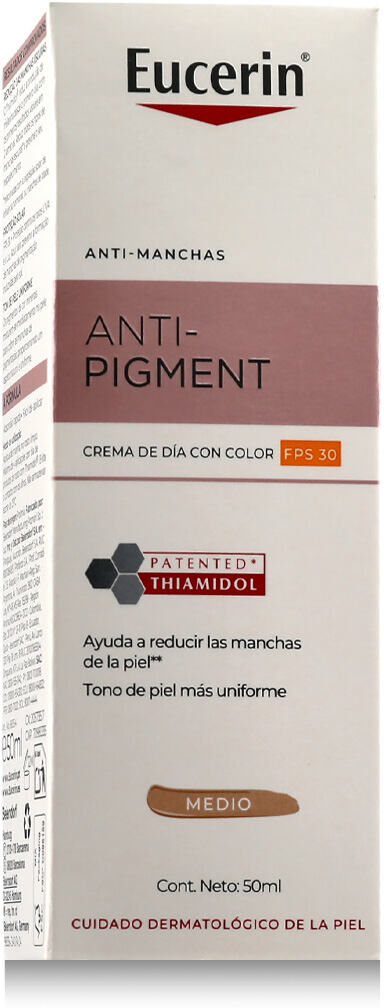
Eucerin Anti-Pigment Day Care Cream SPF 30 (Medium) 50 mlEucerin Anti-Pigment Day Care Cream SPF 30 (Medium) – tinted day cream for dark spots in a 50 ml pack provides multifunctional care that reduces the visibility of dark spots, evens the skin tone and protects against sunlight. It contains patented Thiamidol, which targets the cause of hyperpigmentation, while its subtle tinting effect instantly improves the skin’s appearance. Properties: Tinted day cream with the active ingredient ThiamidolSPF 30 and UVA protection against sun-induced skin ageingMedium shade that adapts to most skin tonesNon-greasy texture that absorbs quicklyDermatologically tested and suitable for daily useKey benefits: Visibly reduces dark spots and evens the complexionHelps protect the skin from new dark spots with UV filtersInstantly enhances the complexion with tinting pigmentsLeaves skin hydrated, soft and visibly radiantSuitable as a lightweight alternative to make-upHow to use: Apply every morning to cleansed skin on the face, neck and décolletageAvoid contact with the eyesUse regularly for long-lasting resultsApply alone or use as a base under make-upFor more intensive care, combine with other products from the Eucerin Anti-Pigment range36,50 €*Shipping: 7,90 €Secure redirect to the provider
-
Are these pigment disorders?
Yes, these are pigment disorders. Pigment disorders refer to conditions that affect the color of the skin, hair, or eyes. In this case, the examples provided - albinism, vitiligo, and melasma - are all pigment disorders that result in abnormal pigmentation of the skin. Albinism is characterized by a lack of melanin production, vitiligo causes patches of depigmented skin, and melasma leads to dark patches on the skin. **
-
Is this a pigment disorder?
Yes, vitiligo is a pigment disorder that causes the skin to lose its color in patches. It occurs when the cells that produce melanin, the pigment that gives skin its color, are destroyed. This results in white patches on the skin that can vary in size and location. **
-
What is a pigment disorder?
A pigment disorder is a condition that affects the color of the skin, hair, or eyes. It can result in an abnormal production or distribution of melanin, the pigment that gives color to these body parts. This can lead to conditions such as albinism, vitiligo, or hyperpigmentation. Pigment disorders can be genetic or acquired, and they can have a significant impact on a person's appearance and self-esteem. **
-
How does the visual pigment work?
Visual pigments are proteins found in the rod and cone cells of the retina that are responsible for capturing light and initiating the process of vision. When light enters the eye and strikes a visual pigment molecule, it causes a chemical reaction that leads to the activation of the pigment. This activation triggers a series of events that ultimately result in the generation of electrical signals that are sent to the brain for processing. Different visual pigments are sensitive to different wavelengths of light, allowing us to perceive a wide range of colors. **
Similar search terms for Pigment
-
What is the pigment in carrots?
The pigment in carrots is called beta-carotene. Beta-carotene is a type of carotenoid, which is a group of pigments that give fruits and vegetables their vibrant colors. In carrots, beta-carotene is responsible for their bright orange color. It is also a precursor to vitamin A, which is important for maintaining healthy vision, skin, and immune function. **
-
How do you mix pigment colors correctly?
To mix pigment colors correctly, start by choosing the primary colors (red, blue, yellow) and white to create a wide range of colors. Begin by mixing small amounts of pigment at a time to avoid wasting materials. Use a palette knife to mix the colors thoroughly on a palette or mixing surface, ensuring there are no streaks or clumps. Remember that different pigments have varying strengths, so adjust the ratios accordingly to achieve the desired color. **
-
How do pigment spots arise from kratom?
Pigment spots can arise from kratom due to the presence of certain alkaloids in the plant, such as mitragynine and 7-hydroxymitragynine. These alkaloids can have an effect on the skin, leading to increased melanin production and the formation of pigment spots. Additionally, prolonged exposure to sunlight while using kratom may also contribute to the development of pigment spots on the skin. It is important to use sunscreen and take proper precautions when using kratom to minimize the risk of developing pigment spots. **
-
Do pigment spots disappear on their own?
Pigment spots, also known as age spots or sun spots, generally do not disappear on their own. These spots are caused by an overproduction of melanin in the skin, often due to sun exposure or aging. While some pigment spots may fade slightly over time, they typically do not completely disappear without treatment. There are various treatments available, such as topical creams, chemical peels, laser therapy, and microdermabrasion, that can help reduce the appearance of pigment spots. It is important to consult with a dermatologist to determine the best treatment option for your specific situation. **
* All prices are inclusive of VAT and, if applicable, plus shipping costs. The offer information is based on the details provided by the respective shop and is updated through automated processes. Real-time updates do not occur, so deviations can occur in individual cases. ** Note: Parts of this content were created by AI.